By Simon Arndt · 7 min. read · Last updated: 8/1/2026
A tool we built for ourselves
Our OKR App was never designed on a whiteboard. It grew out of how we actually work. We started using OKRs years ago, well before the method reached mid-sized companies in our market. What began as an internal stopgap turned into the tool we now use every single day – and offer as a product of its own.
What came out of it: OKR software for teams who want their goals visible without rolling out another heavyweight system. Objectives and key results live in one place, progress calculates itself, and the dashboard shows where things stand at any moment. EU-hosted, set up in minutes, free to use. Try it now – or read on to see how it got here.
The app is built and operated by Merkas Technologies GmbH, a separate company staffed by the same people behind Studio Merkas. That makes it the only project in this portfolio where the client and the development team are one and the same.
You can tell: every function in this app is there for a reason. It exists because we missed it on a real project. And what is missing, is missing on purpose.
From frog's eye to bird's eye
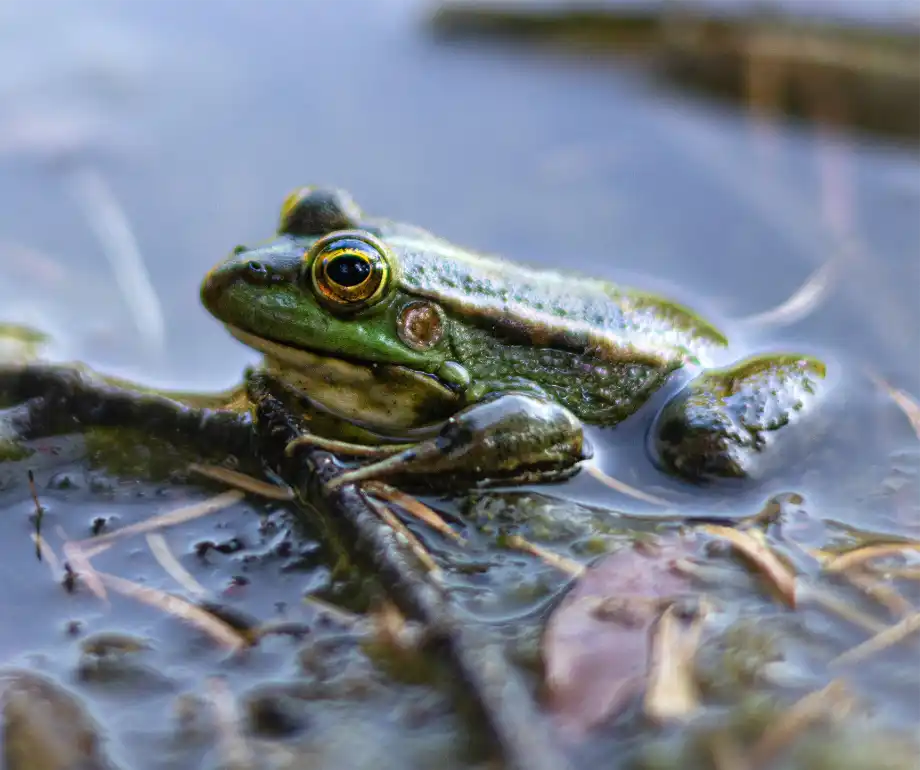
The frog in the grass only sees the next lily pad.
The real problem was the missing overview. We closed plenty of tasks, but nobody could say how far along we actually were. We like to describe it as a frog sitting in tall grass. It sees the next lily pad, the current sprint. What it cannot see is the whole field: how big the project is, where the next obstacles sit, whether it is even heading for the shore. What we lacked was not another lily pad. It was a map of the pond.

The eagle sees the whole field – the bird's-eye view.
That map is exactly what OKRs gave us. Instead of hopping from sprint to sprint, we had the view from above: a clear picture of where the project was heading and what each contribution fed into. The weekly status meeting became pointless, because the state of things was visible to everyone anyway. People knew what to do and why, without anyone having to check up on them. How individual tasks were tracked stayed everyone's own business. The frame was shared, the execution stayed free.
The shift in perspective costs nothing but discipline. No new process landscape, no certification, no consultant. It takes a handful of well-written goals, measurable results, and one place where both stay visible. That place was what we were missing.
From Excel to a system of our own
We started as simply as possible: an Excel sheet with plain progress bars. One bar per goal – which held up for exactly as long as the two of us were working towards the same goals.
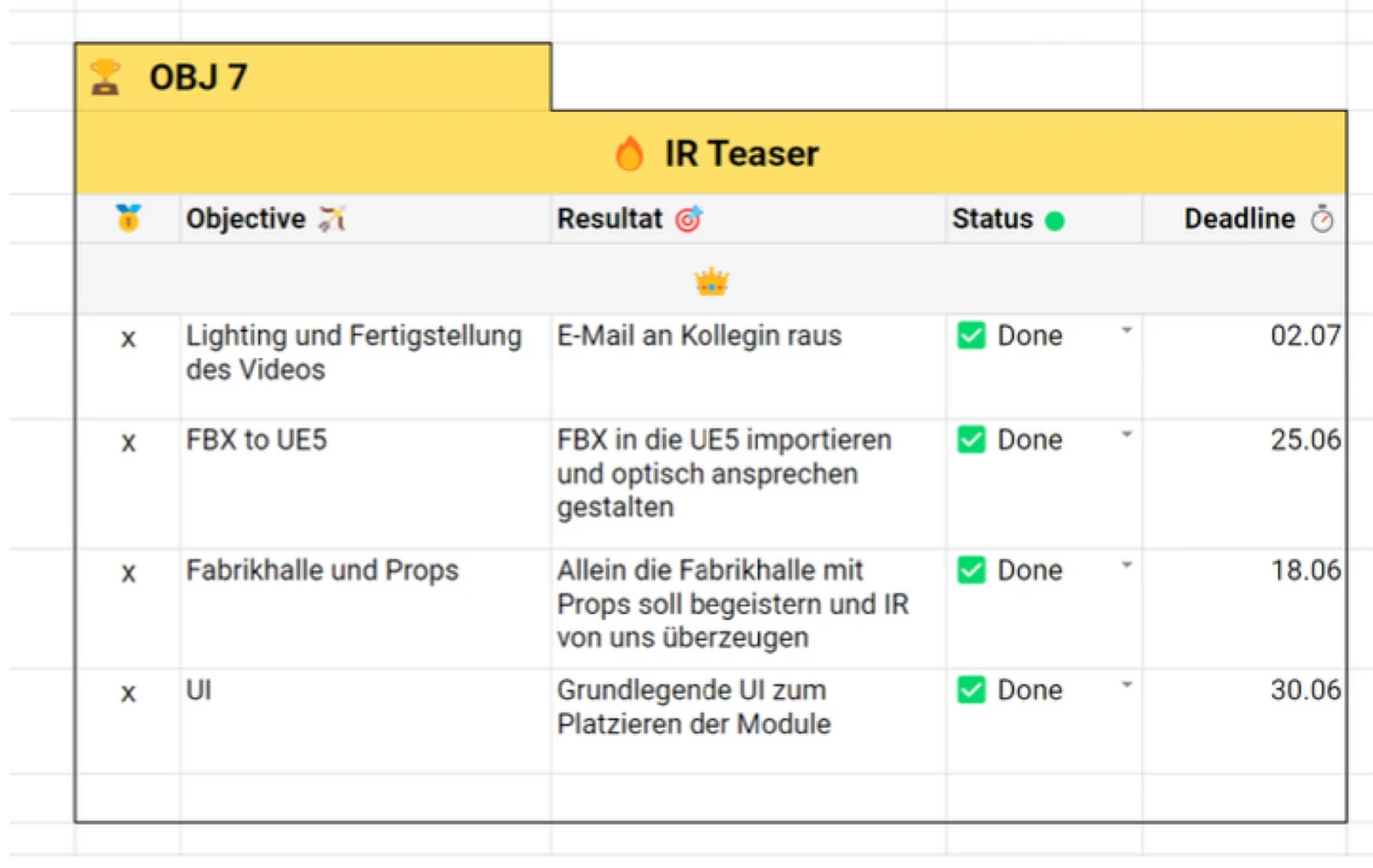
Where it started: OKRs and progress bars in a plain spreadsheet.
The spreadsheet hit its limits fast. Values had to be recalculated by hand, the links between goals existed only in our heads, and the moment a second team joined, everyone maintained their own version. The software available back then either lacked the functions we needed or was hopelessly overloaded.
So we started building our own: first an internal web application, then a second one with progress in real time. Over the years we refined it on live projects and on the feedback that came back from them.
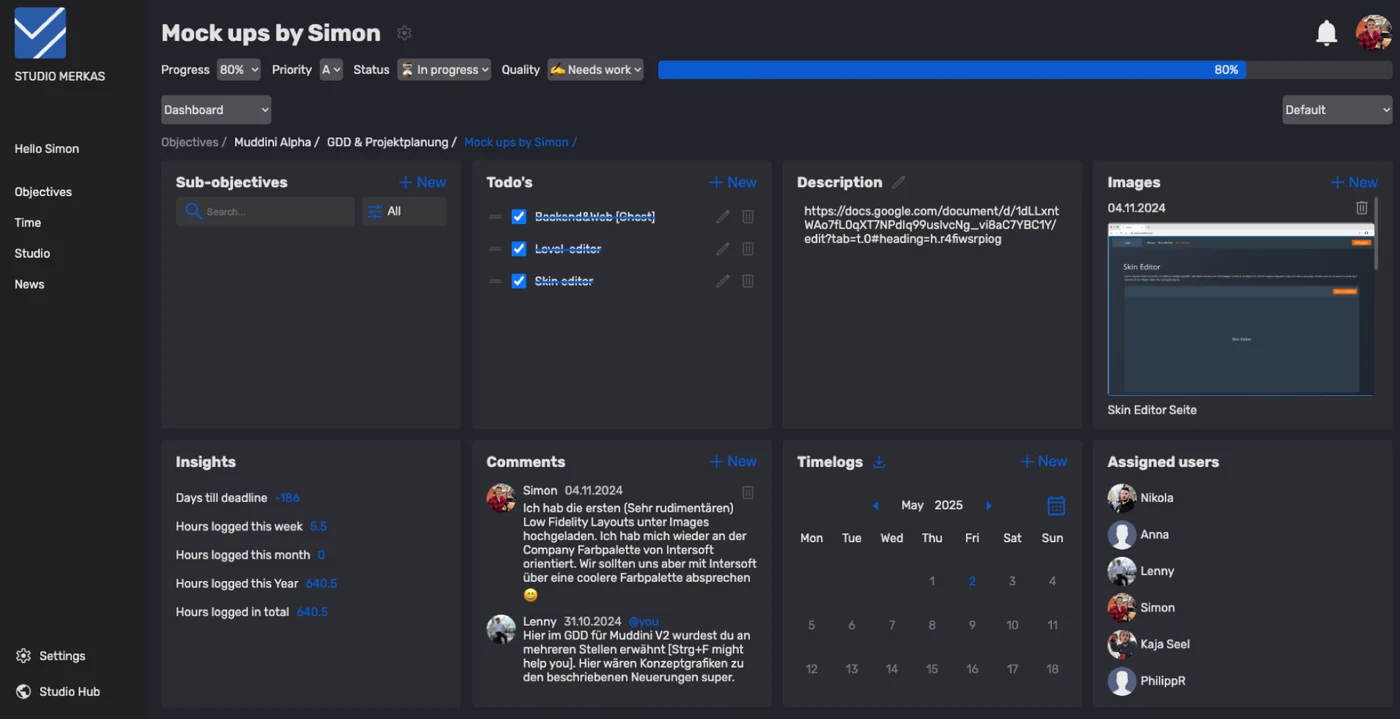
Several iterations turned the internal application into today's app.
The third iteration is what is online today: a lean tool with a clear, list-based view. Objectives and their key results are visibly connected, and every row shows ownership, progress, status and due date. That is the result of years of practice – and of everything we threw back out of the first two versions.
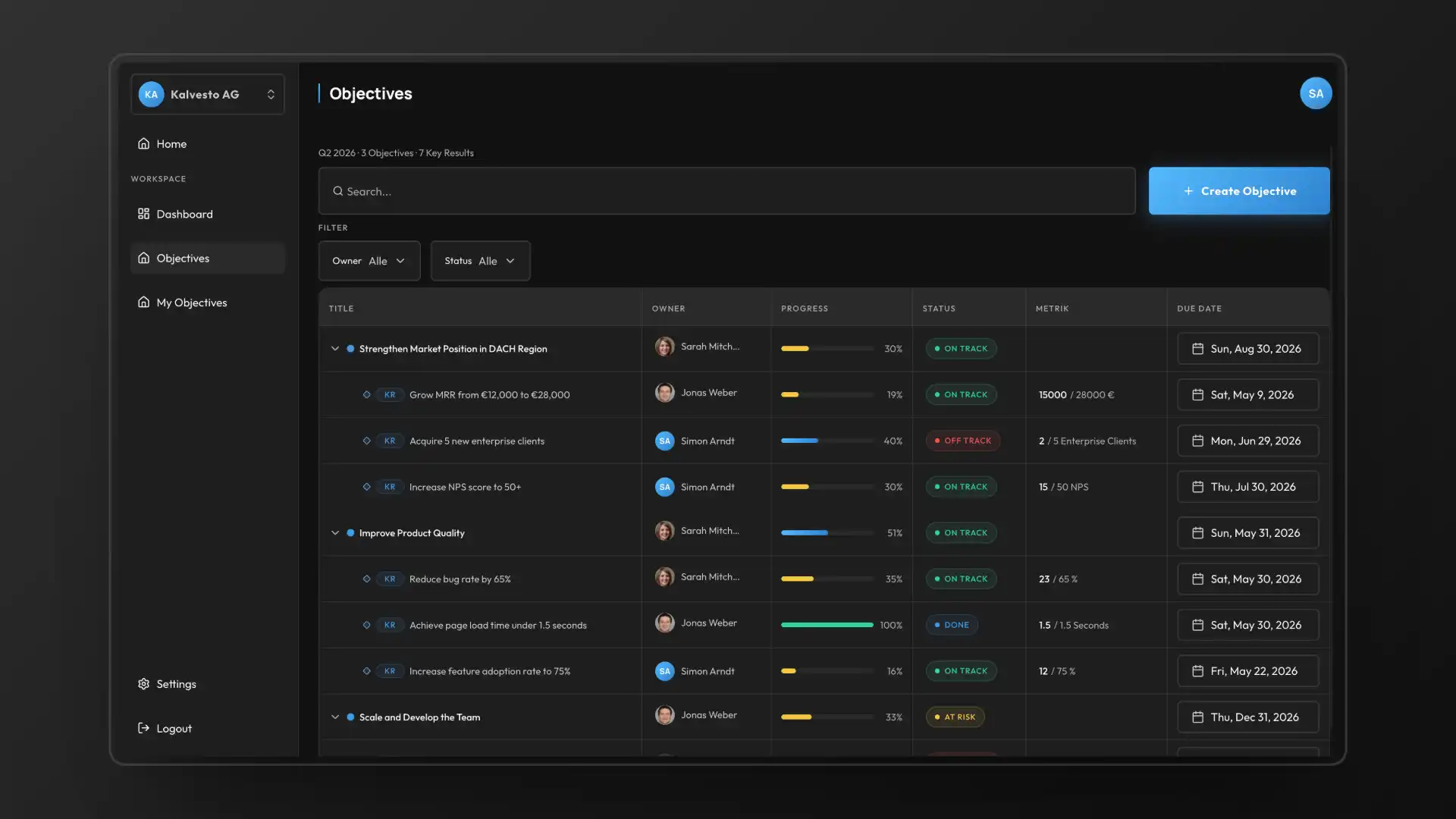
Today's view – one quarter, every objective, key results you can expand.
What we learned – and what came of it
Most features nobody needs. Those years gave us a feel for which functions a team genuinely needs when working with OKRs, and which ones exist to justify a high price tag. Plenty of what shines on a feature list goes unused in practice and slows the software down for everyone else. What came out of it is an application limited to the core of the framework: set objectives, make key results measurable, show progress, align teams. Setup takes minutes and nobody needs training.
OKRs do not work top-down. We learned that they work best when they are shaped by the team rather than handed down. People who help phrase their goals also carry them. That is what our app is built around: everyone on the team sees their own contribution and puts it in, instead of being assigned it.
An OKR tool is not a project management tool. That is the most important lesson, and it is deliberate. Most companies already have tools to manage their projects. Nobody needs another one adding admin overhead. We deliberately start where the OKR method earns its keep: team alignment, focus on the right goals, and the view from above on progress. Which is why comparing it to a large project management platform misses the point – these are two tools answering two different questions, and most teams need both.
In practice that means both can sit side by side. The tickets stay where they are. What gets added is the layer above them.
Core features
The building blocks that keep a team maintaining its OKRs past the third cycle.
Every function in the app has to answer one question: does it help a team keep its goals in view, or does it just create upkeep? Whatever failed that test was never built in the first place.
Goals
Objectives & key results
Every key result gets a start, target and current value. Progress is calculated automatically, with no manual maths.
Alignment
Team alignment
Sub-objectives make it visible which goal feeds into which. Every team member sees their own contribution in the bigger picture.
Overview
Live dashboard
Progress bars, status and trends show immediately where the team is on track and where it is stuck. Always current, with nothing to compile.
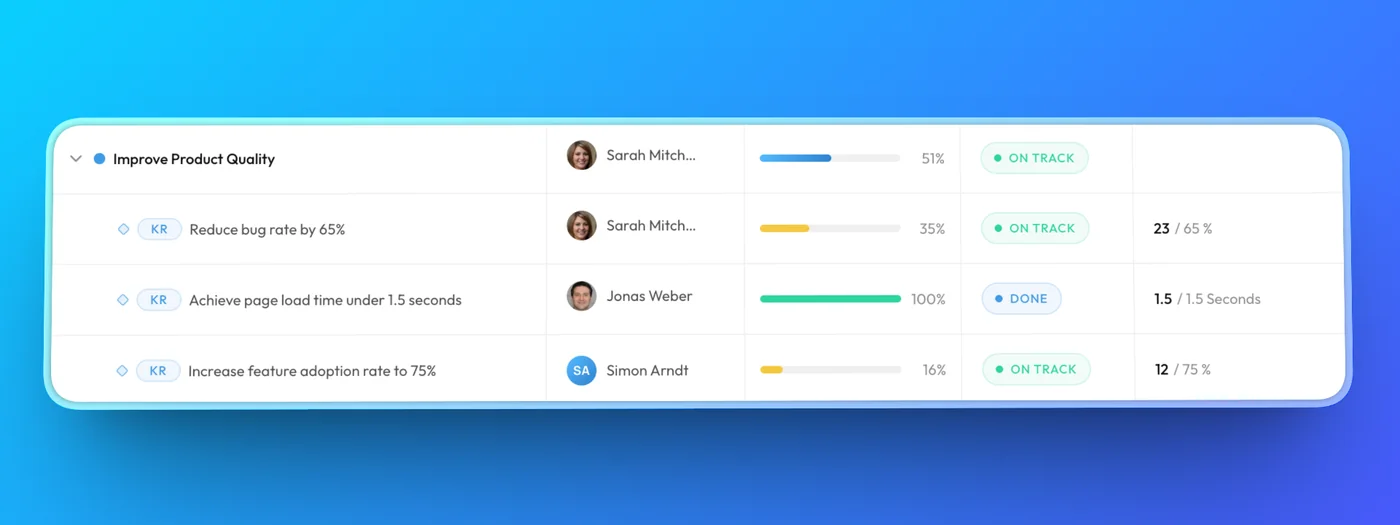
Start, target and current value per key result – progress calculates itself.
Around that sits everything that keeps the day quiet: every objective and every key result has an owner and a due date. A traffic-light status shows whether something is on track, at risk or off the rails. And filtering by owner and status turns “what concerns me?” into a two-click question, even when several teams are running in parallel through the quarter.
Up and running in three steps
From first login to tracked progress takes minutes, not days.
There is no setup project, no implementation phase and no mandatory onboarding call.
- Create a workspace – set up your team and invite members by email. The workspace is the bracket around all of a team's goals.
- Define objectives – phrase your goals and attach measurable key results with a start and target value. Add sub-objectives underneath if you want to show what feeds into what.
- Track progress – update values and watch the dashboard show in real time where the team stands. A short weekly look is enough.
If step two raises the question of whether a goal is well written: that is exactly what Nikola and Simon are there for. It is part of the product, not a paid add-on.
Built for mid-sized teams, not for enterprises
The difference is in the attitude, not in the length of the feature list.
Most OKR tools come out of the US market and are cut for large corporations – with the matching scope, the matching price and the matching distance to the people who made them. We go the other way:
- Support from the people who built it: when you have a question you write to Nikola or Simon, not to a chatbot – about the OKR method too.
- Lean instead of loaded: only what a team genuinely needs to run OKRs well.
- Prices you can follow: the free plan stays free. Paid plans start in the single-digit euro range per month and workspace, cancellable monthly, with no annual contract.
- EU hosting & GDPR: all data sits in an EU data centre. For stricter requirements there is an on-premise option on your own infrastructure.
And because we run the app ourselves every day, feedback does not vanish into a backlog graveyard. What gets built next is decided by what is missing in daily use – yours as much as ours.
Status & roadmap
Where the app stands today – and what comes next.
The open beta is the complete application, not a stripped-down trial. What still gets added extends it and does not invalidate goals you have already set.
Which honestly includes what is missing today: permissions are still coarse – there is the owner of a workspace, and everyone else. For a team working towards shared goals that is enough. Once several departments run in parallel inside one workspace, it is not. So we are building it – exactly when it lands depends on what teams tell us first.
Open beta
Fully usable on the Free, Pro and Premium plans.
In development
Fine-grained roles & permissions, check-ins directly on a key result, and comments on an objective. What ships first depends on what teams need most urgently.
Full launch
(End of 2026)The full launch. Start now and grow with the product.
Start free in the beta
Set up in a few minutes, with no annual contract and no sales call first.
If you want to set up OKRs properly in your team, you can be running in minutes. The free plan is enough to play through a first full cycle. And if questions come up afterwards – about the app or about the method – a message lands directly with us.
Start free in the beta · See pricing · All features · Talk to us about rolling out OKRs
More on OKRs
The basics, the rollout, and why the method is having a moment.
- What are OKRs? The basics, explained simply – objectives, key results, and how they differ from classic target agreements.
- How to implement OKRs: a step-by-step guide – the concrete plan for a first cycle, including the most common mistakes.
- Why OKRs keep getting more relevant – what distributed teams and short planning horizons have to do with the method.
Frequently asked questions
What teams most want to know before they start.
More articles
Games
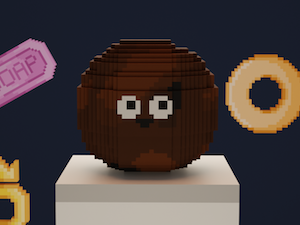
Muddini's Adventure
Muddini's Adventure is a mobile game developed for intersoft AG. Through numerous conversations with intersoft, it became clear to the development studio that the game should be packed with programming jokes and insider references to guarantee the ultimate gaming experience for the intersoft team and all other players.
Educational game
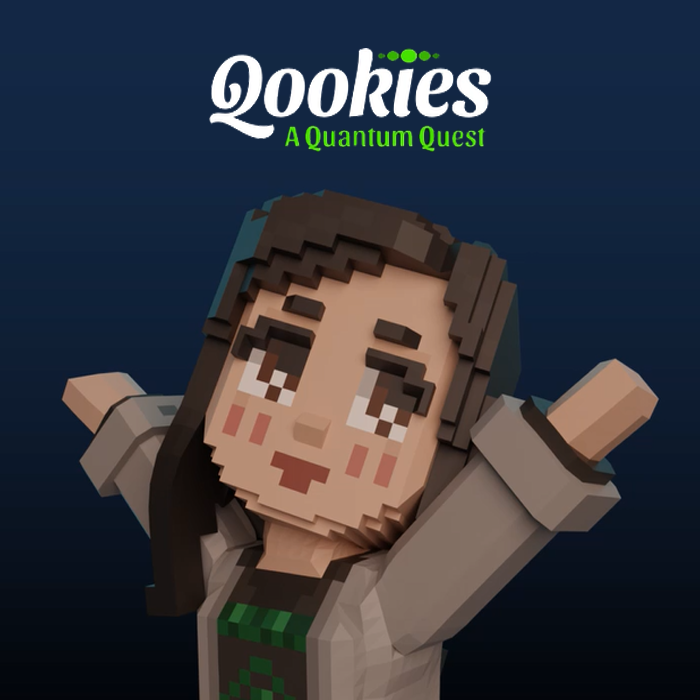
Qookies
Players have the opportunity to collaborate with an AI, solve problems together and make productive learning progress. The AI will learn alongside the player and can be asked at any point how it would approach a given challenge.
Ready to get started?
Let’s start your project.
We appreciate your interest in working with us. Whether you have an idea, a proposal, a question, or need assistance in another area, we’ll get back to you quickly—within 24 hours.
Free initial consultation
Response within 24h
No commitment
Contact
Get in touch
Opening Hours
Mon – Fri, 9:00 – 17:00Response Time
Within 24 hours